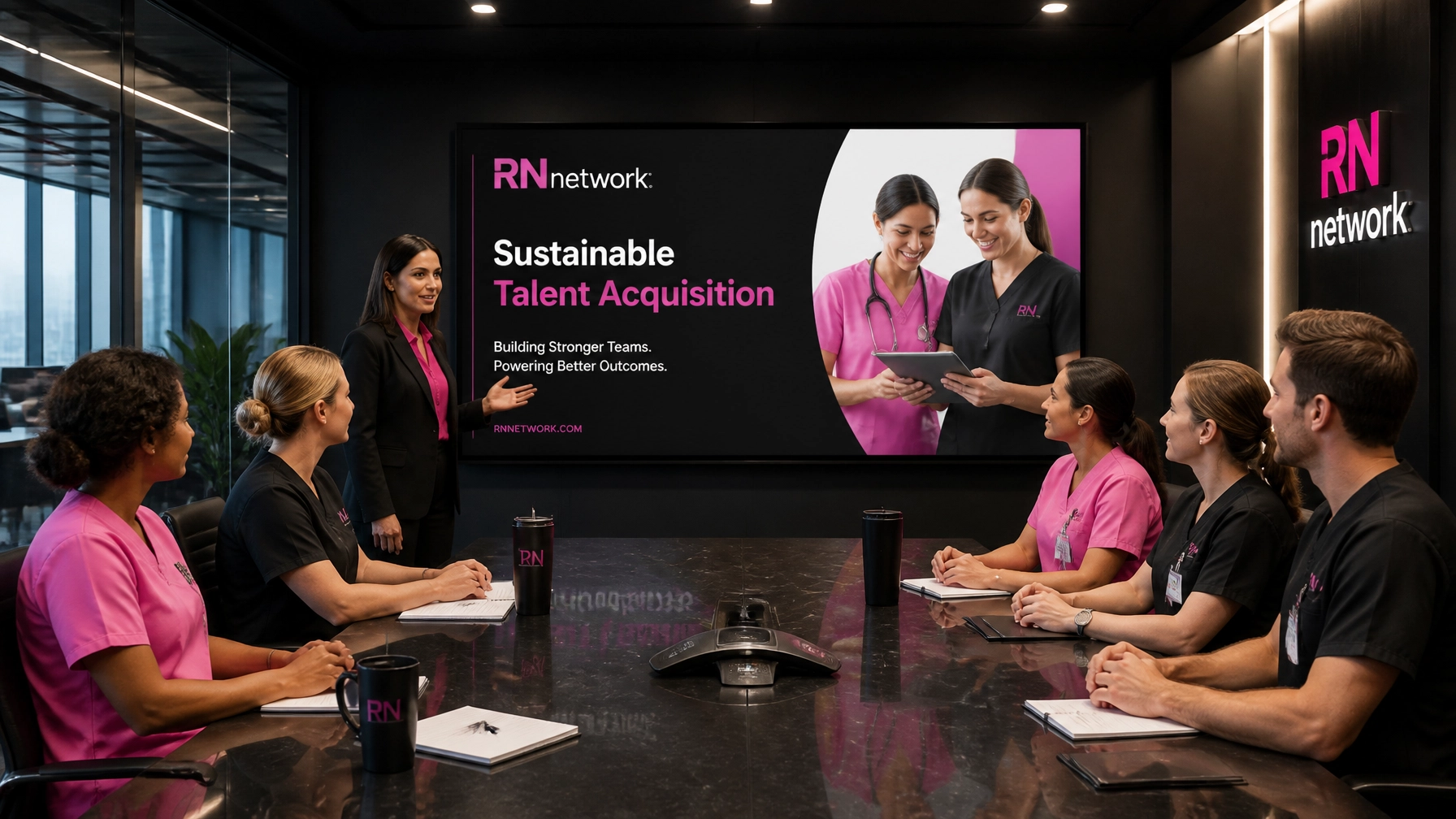
The healthcare landscape of 2026 has officially moved past the "post-pandemic recovery" phase and into a new era of structural transformation. For healthcare employers, HR leaders, and C-suite executives, the rules of engagement have fundamentally changed. We are no longer competing in a market defined by local geography; we are competing in a global, digital-first talent ecosystem where the most skilled nurses prioritize alignment over incentives.
As we examine the current state of nurse recruitment, the data is uncompromising. With a national shortage estimated at 158,600 RNs, the pressure on facilities to maintain safe staffing ratios while managing costs has reached a critical tipping point.
At The RN Network, we view this not as a crisis of labor supply, but as a crisis of strategy. The traditional methods of recruitment — transactional, bonus-heavy, and reactive — are no longer sufficient. To secure the future of your organization, you must shift from a "hiring" mindset to a "talent partnership" mindset.
Below, we break down the data, the failed strategies, and the roadmap forward — section by section. Expand whichever is most relevant to your facility.
To solve a problem of this magnitude, we must first look at the raw data. The 2026 Bureau of Health Workforce Report highlights a persistent gap between the demand for care and the supply of qualified practitioners.
The RN Recruitment Difficulty Index currently sits at 78 days. This means that, on average, it takes over two and a half months to fill a single experienced RN position. For specialized roles, this timeline can stretch to over 120 days. Every day a position remains vacant represents not only a loss in revenue and operational efficiency but an increase in the burnout risk for your existing staff.
Not all nursing units are created equal in the 2026 market. While some areas, such as Pediatrics and Women's Health, maintain relatively stable turnover rates, high-stress environments are seeing unprecedented churn.
Data from the Global Nursing Outlook 2026 suggests that Behavioral Health, Emergency, and Telemetry nurses are the most mobile segments of the workforce. Over a five-year period, these units have turned over their entire staff complement by more than 100%. If your strategy for these departments is still based on the 2020 playbook, you are likely losing more talent than you can replace.
For years, the go-to solution for staffing gaps was the sign-on bonus. In 2024 and 2025, we saw bonuses balloon to $30,000, $50,000, and in some cases, $75,000 for specialized ICU and ER roles.
In 2026, the verdict is in: sign-on bonuses do not work.
While a large upfront payment might attract a nurse to your facility, it does nothing to keep them there. In fact, data shows that "bonus-shopping" has become a career strategy for a subset of the workforce, leading to what we call "synthetic turnover." Nurses stay just long enough to fulfill their contractual obligation — or pay back a pro-rated portion — and move on to the next facility offering a similar incentive.
The failure of the checkbook strategy is rooted in three key factors:
To build a sustainable workforce, your investment must move from the acquisition line item to the alignment and development line items. This is where The RN Network's Employer Solutions provide a unique advantage.

One area of rapid growth and significant recruitment challenge in 2026 is Nursing Informatics. As healthcare systems integrate more advanced AI, predictive analytics, and remote patient monitoring, the need for nurses who can bridge the gap between clinical practice and data science has skyrocketed.
Nursing informatics isn't just about managing the EHR; it's about optimizing workflows to prevent burnout. In our 2026 survey of informatics professionals, 85% stated that their primary goal was to reduce the "documentation burden" on bedside nurses.
The market data reinforces how urgent this has become. For The Record reports that the United States will need more than 56,500 new nurse informaticists over the next decade, with roughly 37,300 openings annually tied to growth and replacement demand. At the same time, the educational pipeline remains narrow — only 2.5% of master's nursing students are specializing in informatics, even as health informatics employment is projected to grow 11% through 2033. That is the definition of a strategic imbalance: enterprise demand is accelerating faster than the specialty pipeline can comfortably supply it.
The talent issue is not just volume. It is capability. Elsevier's Clinician of the Future 2026: Nurses Edition found that only 41% of nurses report their views are reflected in organizational AI decisions, while 68% say they have insufficient AI training and 60% lack confidence in AI governance and oversight. Translation: many health systems are trying to digitize care without enough tech-literate clinical leaders in the room. That gap creates friction in adoption, weakens trust, and slows return on every technology investment.
This is why the shortage in informatics roles deserves its own strategic category. Health systems do not simply need analysts. They need clinical translators, workflow architects, and CNIO-caliber leaders who understand bedside realities, data governance, and change management in equal measure. The Lippincott FutureCare Nursing 2026 Survey found that 75% of senior nurse leaders say technology has already enabled care model changes, and 93% expect it to play a future role. Meanwhile, the 2025 FutureCare findings showed 52% of nurse leaders identified nurse informaticists as one of the most in-demand emerging roles.
For employers, the recruitment implication is clear: if your informatics team is underpowered, your bedside nurses will feel it first. Documentation drag, poor interoperability, clunky remote monitoring workflows, and weak rollout planning all show up as retention problems long before they show up on a dashboard. High-quality healthcare professional networking and internal collaboration platforms are no longer "nice-to-haves"; they are essential components of a modern retention strategy.
A hospital-only view of the nursing labor market is now incomplete. Some of the most consequential recruitment and retention pressure in 2026 is building in non-traditional nursing roles — spaces where nurses are moving for flexibility, autonomy, lifestyle alignment, and new forms of professional influence. If employers ignore these migration patterns, they will misread both supply and attrition.
Home Health Nursing is no longer a peripheral workforce category. It is central to the future of care delivery. The strongest demand drivers are structural: an aging population, increased chronic disease burden, shorter inpatient stays, and a payer environment that increasingly rewards home- and community-based models.
HRSA's 2025 LTSS workforce projections estimate that national demand for the long-term services and supports workforce will rise 40% between 2023 and 2038, from 2.35 million to 3.29 million FTEs. Within that growth, demand for registered nurses in LTSS is projected to increase 39%, while home health aides and related home-based support roles continue expanding in parallel. The Federal Reserve Bank of Kansas City added another layer to the picture in 2026, noting that aging-driven healthcare demand is intensifying at the same time labor supply constraints are tightening, especially in care-heavy fields that rely heavily on women and immigrant workers.
This is not abstract forecasting. PHI's 2025 Direct Care Workers in the United States report projects more than 6.1 million home care job openings between 2024 and 2034 when growth and turnover are combined. That level of churn matters to RN recruitment because unstable aide and support staffing often shifts coordination, supervision, and case complexity back onto nurses.
The retention challenge is just as real. Research published in Health Affairs Scholar found that the home care workforce did not keep pace with the growth of home- and community-based services, with workers per 100 HCBS participants declining as enrollment expanded. In recruitment terms, employers are not merely competing on pay. They are competing on mileage expectations, scheduling predictability, documentation burden, visit density, and safety support in the field.
For nurse leaders, the lesson is straightforward. Home health is no longer the "alternative" path. It is a major growth arena, and organizations that build strong orientation, manageable caseloads, better mobile documentation, and real field support will win.
Aesthetics Nursing has moved from niche to serious recruitment variable. The private wellness and med-spa sector is now competing for licensed nursing talent with a value proposition many bedside employers cannot ignore: predictable schedules, lower physical strain, more autonomy, and often a compensation model that blends salary with incentive upside.
Industry growth explains the intensity. According to 2026 market tracking from AestheticHires, the U.S. med-spa sector now spans more than 11,000 locations, employs 100,000+ workers, and had 1,496 live med-spa job openings posted in mid-June 2026 alone. RepuClinic similarly reported that U.S. med-spa locations jumped from 8,899 to 10,488 in one year, a 17.8% increase, signaling a sharp rise in competition for injectors, aesthetic RNs, NPs, and laser-trained clinicians.
The staffing base remains comparatively small, which is exactly why recruitment is so competitive. Industry estimates suggest roughly 10,000 to 15,000 RNs currently work in U.S. med spas, and about 52% of med spas use RNs or LPNs to perform core cosmetic procedures. Some industry analyses now report that roughly 40% of operators are dealing with staffing shortages they cannot easily fill.
For healthcare employers, the strategic takeaway is not to compete by pretending every nurse wants a med-spa role. The takeaway is to understand that lifestyle, autonomy, and professional identity now carry measurable labor-market value. If a bedside role offers none of those features, private-sector recruiters will continue to have a very easy conversation.
If Home Health represents the decentralization of care, Informatics Nursing represents the operating system behind modern care delivery. The shortage here is less visible than an open ICU requisition, but it can be just as disruptive.
The supply-demand mismatch is widening. National demand points to 56,500+ new nurse informaticists over the coming decade, with 37,300 annual openings. Yet the formal education pipeline remains modest, and many organizations still rely on a handful of "super users" or one overextended informatics leader to support enterprise-scale EHR optimization, AI governance, virtual nursing, and remote monitoring integration. That is not a strategy. That is wishful staffing.
The market is already signaling how strategic these roles have become. HIMSS updated nursing informatics role descriptions in 2025, and executive search commentary in 2026 highlights the expanding influence of the Chief Nursing Information Officer as the nursing voice in digital strategy, analytics, AI implementation, and workflow design.
Retention in informatics also deserves attention. These nurses are highly marketable, often cross-recruited into consulting, vendor roles, digital health companies, and enterprise leadership positions. Tech-literate clinical leaders know their value. In 2026, the market knows it too.
The final non-traditional pressure point is not a niche specialty at all. It is Nurse Leadership itself. Across systems, there is a quiet but consequential leadership drain happening at the manager, director, and executive levels.
The AONL Foundation's Nursing Leadership Insight Study 2025 found that 23% of nurse leaders plan to leave in the foreseeable future and another 23% may leave. Among those intending to exit, the leading reasons include seeking promotion or new opportunity (39%), negative effects on health and well-being (37%), and retirement (26%).
The pipeline concern deepens when we look at broader workforce aging. The WHO's State of the World's Nursing 2025 reports that 19% of nurses globally are age 55 or older, and in 20 countries, retirements projected over the next decade are expected to outnumber early-career entrants.
Leadership stability has direct operational consequences. Press Ganey's 2026 nursing findings show that early-career attrition remains high, with about 20% of early-career nurses leaving their organizations. Retention at the bedside is heavily shaped by local leadership quality, staffing support, scheduling fairness, coaching, and trust.
This is why nurturing the next generation of CNOs, Directors, and nurse executives is not optional. It is a workforce protection strategy. Leadership development should not begin when the director resigns. By then, the fire is already in the drywall.
If bonuses are the "sugar rush" of recruitment, cultural alignment is the "nutrition." In 2026, nurses are looking for organizations where their personal values align with the facility's operational health.
What does cultural alignment look like in practice?
Nurses who feel aligned with their organization are 3x more likely to stay beyond the five-year mark, regardless of salary fluctuations in the market. Organizations must stop viewing nurses as "shifts to be filled" and start seeing them as "partners in care." This shift in perspective requires transparency in staffing ratios, a commitment to mental health resources, and a focus on long-term nursing career development.
The 2026 nurse is a lifelong learner. They are highly attuned to their "market value" and are constantly seeking ways to improve their clinical skills.
The data is clear: facilities that offer robust Clinical Ladders, support for Specialty Certifications, and pathways into Advanced Practice (NP, CRNA, CNS) have 20% lower turnover rates than those that do not.
By providing a clear roadmap for growth, you signal to your talent that you are invested in their future. At The RN Network, we facilitate this through our Career Resources and Salary Database, allowing nurses to see the tangible benefits of staying within a supportive ecosystem.
Navigating the 2026 recruitment landscape requires a multi-faceted approach. Based on our work with top-tier healthcare institutions, we recommend the following strategic pillars:
With a difficulty index of 78 days, you cannot afford a slow, bureaucratic hiring process. Audit your credentialing and interviewing workflows. Leverage nurse networking platforms to build a "warm lead" pipeline before positions even open.
Stop selling the job; start selling the mission. Use your recruitment materials to highlight your culture, your commitment to safety, and your technological infrastructure. If you don't have a strong employer brand, you are just another name on a job board.
Don't wait for an exit interview to find out why your best talent is leaving. Conduct regular "Stay Interviews" with your high-performers to understand what keeps them engaged and what pain points could be mitigated.
The days of generalist recruiters are over. You need a partner who understands the nuance of nursing — from the difference between an ICU and a CVICU nurse to the specific needs of a Telemetry unit. The RN Network acts as this professional bridge, connecting facilities with talent that is not just qualified, but aligned.
Get the free weekly Hiring Intelligence Report — nurse turnover, vacancy, and pipeline data curated for the people who hire nurses.
Get the Free Weekly Report →At The RN Network, we don't just provide a platform; we provide a solution to the talent crisis. Our ecosystem is designed to support the entire lifecycle of a nurse's career, making us the ultimate destination for high-quality healthcare talent.
When you partner with us through our Employer Solutions, you gain access to:
We understand that a hospital is only as strong as its nursing staff. By focusing on alignment, professional development, and sophisticated communication tools, we help you build a workforce that isn't just "there for the shift," but there for the mission.
The 2026 nurse recruitment crisis is not an insurmountable obstacle; it is a catalyst for necessary change. The facilities that will thrive in this environment are those that reject the short-term fix of sign-on bonuses in favor of long-term investments in their people.
Explore Employer Solutions →