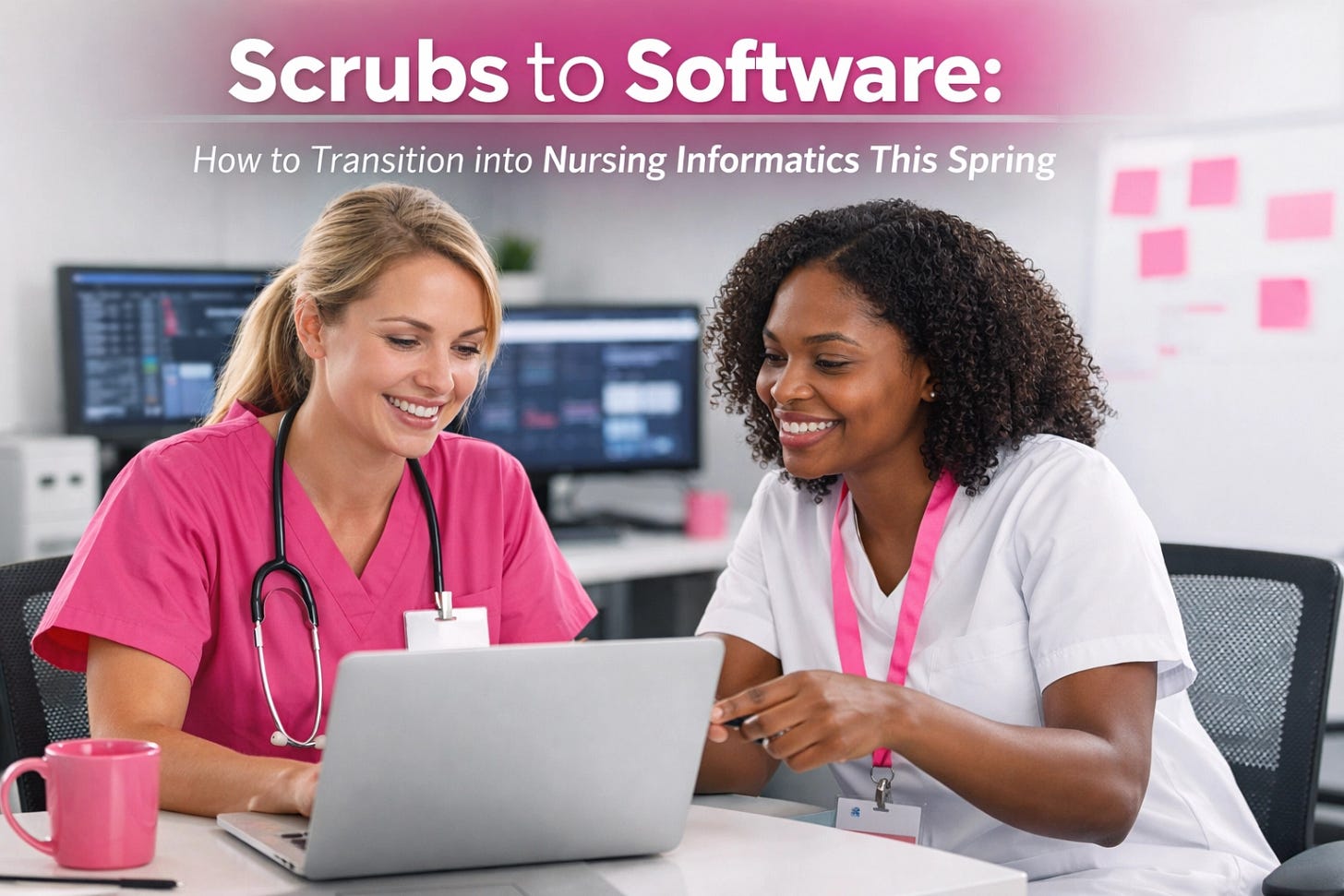
It is Thursday, March 26, 2026. The cherry blossoms are starting to pop, the sun is staying out longer, and if you are like most of the nurses I talk to lately, you are looking for a fresh start. As a recruiter here at The RN Network, I spend my days scanning resumes and talking to talent. Lately, the biggest trend I am seeing isn’t just travel nursing: it is the Great Pivot into Nursing Informatics.
If you have spent the last few years at the bedside, you have likely felt the strain of what we in the industry call the “experience-complexity gap.” Patient acuity is higher than ever, and the systems we use to manage them are becoming incredibly complex. This gap is exactly where you come in. Informatics isn’t just about “fixing the computer”: it is about bridging the divide between clinical expertise and technological efficiency.
Let’s look at how you can transition from the floor to the keyboard this spring.
Understanding the 2026 Landscape: The Experience-Complexity Gap
We are currently navigating a unique era in healthcare. By 2026, the integration of AI-assisted diagnostics and remote patient monitoring has moved from “future tech” to “daily standard.” However, there is a massive problem: the people building these systems often don’t understand the workflow of a busy med-surg floor or a chaotic ICU.
The experience-complexity gap occurs when the technology intended to help nurses actually adds to their cognitive load because it wasn’t designed with a clinical brain.
As a recruiter, I see hospitals desperate for Informatics Nurses because they need people who can translate “nurse speak” into “dev speak.” They need someone who understands that a 3-second delay in a charting system can lead to a 30-minute backup in patient care. Transitioning into this field means you are the solution to this gap. You are the one ensuring that technology serves the clinician, not the other way around.
What Does an Informatics Nurse Actually Do?
Before you jump into a new career path, let’s define the role. In 2026, a Nursing Informatics Specialist (NIS) typically focuses on:
Systems Optimization: Ensuring the Electronic Health Record (EHR) actually works for the staff.
Data Analytics: Using patient outcomes to suggest changes in protocol.
Education: Training clinical staff on new software or hardware implementations.
Quality Improvement: Using tech to reduce medication errors and improve patient safety.
Remote Monitoring Oversight: Managing the data flow from “Hospital at Home” programs.
Phase 1: The Spring Inventory (March – April)
You don’t need to quit your job tomorrow to start this transition. In fact, most of the successful pivots I see happen while the nurse is still working at the bedside. Use this spring to build your foundation.
1. Become a Super User
Every time your unit rolls out a new update to Epic, Cerner, or Meditech, volunteer to be the Super User. This is the single best way to get “Informatics” on your resume without changing your job title. You get early access to training and a look behind the curtain of how systems are implemented.
2. Join the Informatics Committee
Most hospitals have a Professional Governance or Informatics Committee. Join it. If your hospital doesn’t have one, ask your manager if you can start a workgroup focused on “Workflow Efficiency.” This shows leadership and initiative: two things I look for when I am hiring for high-level roles.
3. Check the Data
Before you commit to a new degree, see what the market looks like. Use the RN Network Salary Database to check what Informatics Nurses are making in your specific zip code. In 2026, salaries have shifted significantly due to the remote work boom, so ensure you have the most recent data.
Phase 2: Building the Technical Foundation
I often hear nurses say, “I’m not tech-savvy.” Let me let you in on a secret: if you can navigate a modern EHR, manage a smart pump, and troubleshoot a telemetry monitor while a patient is coding, you are more tech-savvy than 90% of the population.
However, you do need some specific skills to catch a recruiter’s eye:
Data Visualization: Learn the basics of tools like Tableau or PowerBI. Hospitals love seeing that you can take a spreadsheet and turn it into a readable chart.
Database Knowledge: You don’t need to be a coder, but understanding how SQL works (how data is pulled from a database) is a huge plus.
Project Management: Informatics is 50% tech and 50% project management. Familiarize yourself with Agile or Lean methodologies.
Phase 3: The Educational Path (The MSN Debate)
I get asked this every day: “Do I really need a Master’s degree?”
The short answer is: In 2026, it helps significantly. While you can get entry-level roles with a BSN and experience, the high-paying, leadership, and remote roles usually require a Master of Science in Nursing (MSN) with a focus on Informatics.
The Timeline
If you have an ADN: Look into RN-to-BSN programs first. You can usually knock this out in under two years while working.
If you have a BSN: An MSN in Nursing Informatics typically takes 1.5 to 2 years.
Certification: Once you have the experience (usually 2,000 hours in an informatics-related role), you should sit for the Informatics Nursing Certification (NI-BC) from the ANCC.
When I look at a stack of resumes for a remote Informatics Consultant role, the “NI-BC” credential acts as a high-level filter. It proves you have the theoretical knowledge to back up your clinical experience.
Phase 4: Networking and Your “Digital Footprint”
Spring is the perfect time for professional “spring cleaning” of your online presence.
Update your LinkedIn: Change your headline from “RN at City Hospital” to “RN | Aspiring Informatics Specialist | EHR Super User.”
Connect with Professionals: Reach out to Informatics Nurses at your current facility. Ask for a 15-minute coffee chat.
The RN Network Resources: Utilize our Free Resources to find templates for transition resumes.
Why Recruiters Love Informatics Candidates Right Now
From my perspective as a Talent Acquisition advisor, the “Informatics Nurse” is the ultimate unicorn. You possess “Dual Fluency.” You can talk to a surgeon about sterile fields and then turn around and talk to a software engineer about API integrations.
In the current 2026 market, we are seeing a massive shift toward Remote Patient Monitoring (RPM). Companies are hiring nurses to manage “Virtual Command Centers.” These roles offer:
Standard 9-5 hours (usually).
Remote work options.
Competitive salary packages (Check the Salary Insights for details).
A break from the physical toll of bedside nursing.
How to Handle the “Bedside Guilt”
Transitioning away from the bedside often comes with a side of guilt. You feel like you are “leaving the trenches.”
Here is how I want you to reframe that: By moving into Informatics, you are helping every nurse on your unit. When you help design a better documentation flow, you are saving 50 nurses 20 minutes a shift. That is a massive impact on the healthcare system as a whole. You aren’t leaving nursing; you are scaling your nursing impact.
Taking the First Step: Your Spring Action Plan
If you want to be in a new role by the time the leaves start changing this fall, follow this checklist:
Week 1: Register for an account on The RN Network to start tracking job trends.
Week 2: Review the Salary Database to set your income goals.
Week 3: Schedule a meeting with your current manager to discuss becoming a Super User or joining an informatics project.
Week 4: Look into coaching options. If you feel stuck, our Coaching Section can help you map out your specific transition.
Final Thoughts from Christina
The transition from scrubs to software isn’t just a career change: it’s a lifestyle upgrade. The 2026 healthcare market is hungry for your clinical expertise. Don’t let the technical jargon intimidate you. You already handle the most complex machine in existence every day: the human body. Learning a new software system is easy compared to that.
Ready to see what’s out there? Head over to our Job Board and filter for “Informatics” or “Digital Health.” You might be surprised at how many companies are looking for someone exactly like you.
Happy Spring, and here’s to your new career!
Need more help?
Check out our Income Hub for side hustle ideas while you transition.
Sign up as a Talent Agent to help other nurses find their path.
Visit the Help Center if you have questions about using our platform tools.
Ready to Take the Next Step?
Join 200,000+ nurses who trust The RN Network for career insights, job opportunities, and salary data.
Join Free Today