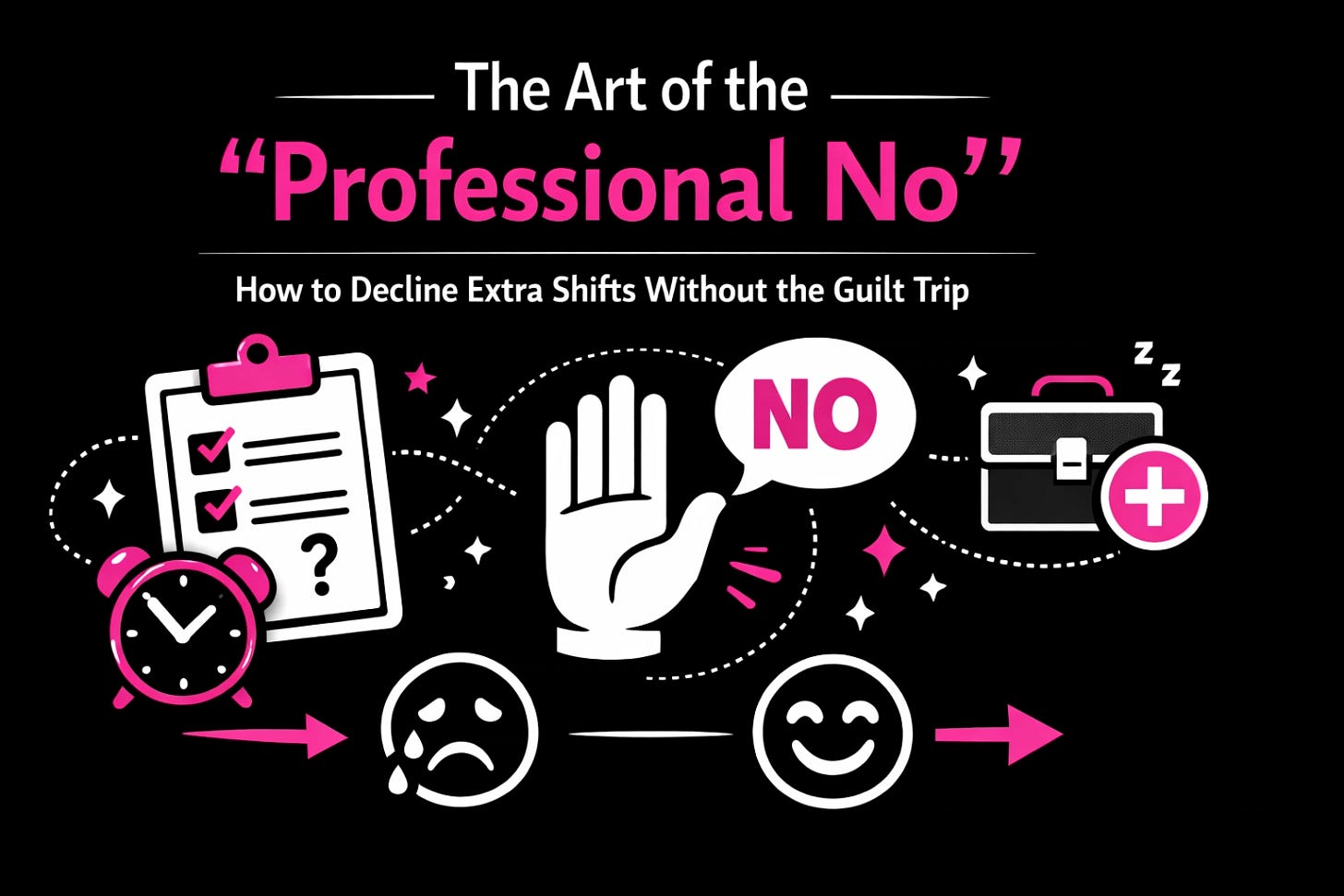
It’s 2:00 PM on your first day off after a grueling three-day stretch. You’ve finally managed to sit down with a hot cup of coffee, the silence of your house feeling like a luxury. Then, the buzz happens. That familiar, sharp vibration of your phone on the coffee table. You don’t even have to look at it to know what it is. It’s the unit manager. It’s a text from the scheduling coordinator. It’s a notification from one of those nurse communication tools asking, no, pleading, for someone to pick up a night shift because “the unit is drowning.”
Your stomach drops. That familiar wave of “Nurse Guilt” washes over you. You start calculating: If I go in, I’ll have enough for that vacation fund... but if I go in, I might actually cry in the supply closet.
Sound familiar? You’re not alone. I’m Christina Archer, and I work in Nurse Talent Acquisition—meaning I talk to nurses every week about what makes a career sustainable (and what quietly burns people out). If there is one thing I tell the nurses I hire, it’s this: your “Yes” has no value if you don’t know how to say “No.”
Today, we’re diving into why nurses feel obligated to say yes, the data that connects fatigue to patient risk, and how to use the “Professional No” as a career-sustainability skill that protects your nursing career development.
The Psychology of the “Yes”: Why Nurses Are Programmed to Overcommit
Why is it so hard? From a recruiter’s chair, I see the same pattern everywhere: nursing culture rewards the helpers, the fixers, and the ones who show up when things get messy. There’s a “Florence Nightingale Shadow” effect—an internal pressure to be a martyr for the cause.
The guilt usually stems from three places:
The Hero Complex: We feel that if we don’t go in, the patients won’t be safe.
Peer Pressure: We don’t want to let our coworkers down because we know how much it sucks to work short-staffed.
Fear of Retaliation: The subtle (or not-so-subtle) worry that saying no will affect our standing, our evaluations, or our future opportunities.
But here is the reality check: You cannot pour from an empty cup. When you say yes to an extra shift out of guilt, you aren’t being a hero; you’re increasing the risk of burnout.
The Data Doesn’t Lie: Burnout and Patient Safety
Let’s get into the nitty-gritty. We often think that by picking up that extra shift, we are “saving” the unit. But the data suggests something much darker. Multiple studies have shown a direct correlation between nurse fatigue and medical errors.
According to research on nurse staffing and patient safety, nurses working shifts longer than 12 hours or working more than 40 hours a week are significantly more likely to make errors in medication administration and documentation. Fatigue impairs your cognitive function similarly to alcohol intoxication. Would you want a nurse who is “drunk” on exhaustion hanging your IV meds? Probably not.
Burnout isn’t just a buzzword; it’s a clinical reality. High turnover rates in hospitals are often fueled by the “always-on” culture. From a talent acquisition perspective, boundary-setting is one of the most reliable predictors of who stays in the profession (and who ends up job-hopping or leaving entirely). By learning to set boundaries, you aren’t just protecting your mental health—you’re making a long-game nursing career development move by staying well enough to keep options open. If you’re feeling the weight of the bedside, check out career coaching to map out a path that fits your life.
Flipping the Script: The “No” Is a Professional Decision
We need to stop viewing “No” as a personal rejection or a sign of weakness. Instead, view it as a professional assessment of your capacity.
When a manager asks you to work, they are looking for a resource. When you decline because you are exhausted, you are providing an honest report of that resource’s availability. You wouldn’t use a piece of equipment that was malfunctioning or uncalibrated, right? Treat yourself with the same professional standard.
If you are looking for more ways to manage your professional trajectory and see what your skills are actually worth without the extra overtime, check out the salary database to gain some perspective.
How to Say No: Scripts That Work
One of the biggest hurdles is simply knowing what to say. You don’t want to sound rude, but you also don’t want to leave the door open for them to talk you into it. The key is to be direct, polite, and brief. You do not owe anyone a 20-minute explanation of your weekend plans.
1. The “At Capacity” Response
This is perfect for when you are genuinely tired and just need a break.
The Script: “I’d love to help out the team, but I’m currently at capacity and need this time to recharge so I can give my best to my scheduled shifts. Thanks for thinking of me!”
2. The “Prior Commitment” Response
Use this when you have plans, even if those plans are just sitting on your couch in your pajamas.
The Script: “Thanks for reaching out! I have a prior commitment and won’t be able to pick up that shift. I hope the unit finds coverage soon!”
3. The “Focusing on Growth” Response
If you are currently working on certifications or further education, use it! It shows you are committed to the profession.
The Script: “I’m currently focusing on my [Name of Certification/Course] and have dedicated my days off to study. I can’t take on extra hours right now, but I’ll let you know if my schedule opens up.”
4. The “Check the Schedule” Delay
If you feel pressured to answer immediately, buy yourself some time.
The Script: “Let me check my personal calendar and get back to you in an hour.” (This gives you time to gain your composure and send a text “No” rather than a pressured “Yes” over the phone.)
Setting Boundaries That Stick
Saying no once is great, but creating a culture where your boundaries are respected is the real goal. Here is how you make those boundaries stick:
Turn Off Notifications: Use nurse communication tools to your advantage. Most apps allow you to set “Do Not Disturb” hours. If it’s your day off, your phone shouldn’t be buzzing with work alerts.
Don’t Over-Explain: The more you explain, the more “hooks” you give a manager to try and solve your problem for you. “I can’t because my car is in the shop” leads to “Oh, we can get you an Uber!” Just say you aren’t available.
Be Consistent: If you say no to extra shifts consistently, people will stop seeing you as the “easy yes” and will only ask when it’s absolutely necessary.
Utilize Resources: If you feel like your current workplace doesn’t respect boundaries no matter what you do, it might be time to browse the job board for a culture that better aligns with your values.
Reframing the Guilt: You Are Doing Your Job
I want you to repeat after me: Rest is a professional requirement.
In nursing, we talk a lot about “patient-centered care,” but we often forget that the most important tool in that care is you. When you decline an extra shift, you are choosing to be a better nurse for the shifts you are scheduled for. You are choosing to be a more present parent, partner, and friend. You are choosing to prevent the kind of soul-crushing burnout that leads nurses to leave the bedside forever.
If you’re struggling with the transition from “People Pleaser” to “Protected Professional,” you aren’t alone. Connecting with a community that understands these struggles is vital. Consider joining The RN Network to find peers who are navigating these same waters.
Final Thoughts: Your Career, Your Rules
From a Nurse Talent Acquisition standpoint, this is what I want for every nurse I hire: a career that lasts. The RN Network, LLC is here to support your growth, not just your productivity. Use free resources to tighten your resume, or connect with a talent agent to find a role that respects your time and your limits.
The next time that phone buzzes on your day off, pause before you reply. Check your energy. Protect your next scheduled shift. Send the professional “No,” turn on Do Not Disturb, and get back to your life. The nurses who do this are the ones still thriving five years from now.
Ready to take the next step in your professional journey without the burnout? Sign up today and let’s build a career you actually love.
Looking for more tips on nursing career development? Check out our Help Center or browse our Shop for tools designed to make your nursing life easier.
Ready to Take the Next Step?
Join 200,000+ nurses who trust The RN Network for career insights, job opportunities, and salary data.
Join Free Today