

Sponsored by 200 AI Prompts for Healthcare Recruiters
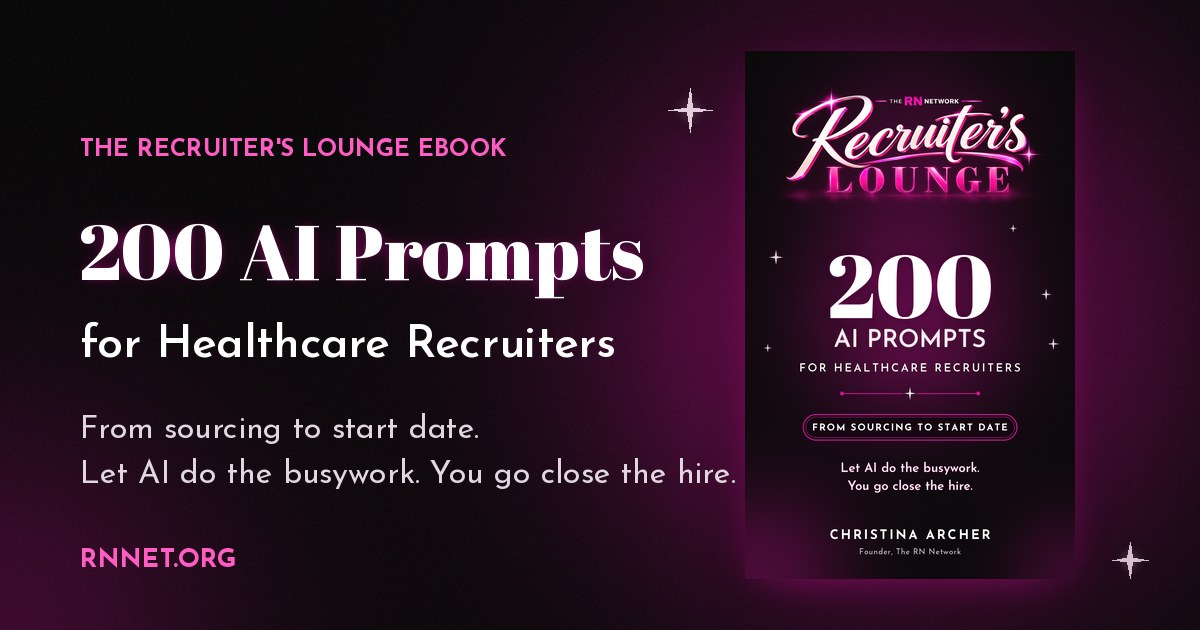
Everyone tells you to use AI. Nobody tells you what to type.
That is the whole gap. It is why most recruiters try this twice, get back something that reads like a brochure, and quietly go back to doing it by hand. Two hundred prompts written for nurse hiring specifically — debriefs, competency scoring, reference summaries, intake questions, sourcing notes, and the regret note you have rewritten four times this month. Copy, paste, change the name.
Get the prompts →This week’s sponsor is our own book, so no commission changes hands.
The short version
- Talent acquisition is the most AI-adopted function in all of HR, not the laggard.
- About half of HR professionals using it report no gain in decision-making, or in decision speed.
- Forty-eight hours from final interview to a yes or a no is the target. Four things have to be true first.
- Your screening model is probably narrowing your shortlist every cycle, and there is research explaining exactly why.
- One thing you may be paying a vendor for, the state boards of nursing give away free.
Ask a health system executive whether the organization uses AI and you will get a list. Ambient documentation. Sepsis prediction. Revenue cycle.
Ask the recruiting desk what AI did for their last nurse hire and you get a pause, then something about scheduling.
That pause is the whole newsletter.
The one number that should bother you
Recruiting is not the laggard here. It is the leader. SHRM’s State of AI in HR 2026, built on 1,908 HR professionals, puts talent acquisition at 27% of organizations — the most AI-adopted function in HR, ahead of HR technology and learning and development. Among employers with 5,000 or more people, which is nearly every health system, 60% have it running somewhere in HR.
It is working, too. 87% of HR professionals using AI report better efficiency. 75% report better work quality.
Then there is the number that should bother you. About half report no improvement in their decision-making, or in the speed with which hiring decisions actually get made.
The first half of that is SHRM’s finding. The second half is mine, and I have never once seen a requisition move faster because the scheduling got automated.
You automated the easy half. The part where somebody finally says yes or no is sitting exactly where it has always been.
What has to be true for forty-eight hours to work
Forty-eight hours from final interview to a yes or a no. Not ambitious, just rare, because four things have to be in place first. None of this comes from a study. It is what works, it costs nothing, and most of it is a prompt and a calendar change.
Set the clock at intake, not at offer. Agree the forty-eight hours with the hiring manager before the req ever posts, when it is an abstraction and nobody is defending a favorite candidate. A deadline introduced after the final interview is a negotiation. One agreed at intake is a process.
Write the debrief before the panel meets. Feed in your interview notes and ask for a one-page side-by-side of every finalist against the posted competencies. Panels burn their first twenty minutes reconstructing who said what. Walk in with that already done and the meeting starts at the argument instead of the recap. This is the single thing that makes the clock survivable.
Score against the job, never against each other. Two people can argue about a ranking forever and still agree on whether somebody can run a four-patient assignment. Ask for an independent rating against the posted competencies, one candidate at a time, and let the panel react to that.
Draft the offer and the regret note at the same time. Both ready before the decision meeting, so the only thing left in the room is the decision. Sounds trivial. Routinely saves two days, because the yes stops waiting on somebody to go find the template.
Summarize every reference the hour it lands. Three lines against the competencies, same day. References are supposed to inform the decision, not ratify one that already happened.
Why your shortlist keeps looking the same
One finding is worth your time here, because it explains that decision-making number better than anything else I have read this year.
Danielle Li, Lindsey Raymond and Peter Bergman studied 88,666 applications at a Fortune 500 firm and ran two screening algorithms over the same pool. The first ranked candidates by predicted quality, which is what most products do. The second added an exploration bonus, giving extra weight to applicants whose profile was rare in the training data — the ones the model knew least about.
Human recruiters picked a pool that was 10% Black or Hispanic, with a 10% hiring yield. The prediction model dropped representation to roughly 2% and lifted yield to 15%. The exploration model took representation to 23% and yield to 25%.
The model told to go find candidates it did not understand beat the model told to pick winners.
A screen trained on your last hundred hires learns your last hundred hires. Every cycle it grows more confident about a narrower profile. So if your med-surg shortlists all look alike, that is not culture fit. It is a sampling problem, and it is part of why critical care sits open 82 days.
Two things worth checking before Monday
Whether the law already applies to you. Nineteen states had AI workplace legislation on the books at the time of SHRM’s research, and 57% of HR professionals in those states did not know. Just under half of organizations have a formal AI policy at all. If your team is already matching resumes with AI, that exposure belongs to you, not to legal. One email this week.
Whether you are paying for something free. Nursys e-Notify, run by the National Council of State Boards of Nursing, sends employers automatic real-time alerts on nurse licensure status, public discipline, expirations and compact changes, and issues an NCSBN ID you can carry in your own systems. More than 16,000 healthcare institutions are enrolled and it costs nothing. If a vendor is invoicing you to watch nurse licenses, go and look at what you are actually buying.
The days you can still get back
Experienced RN requisitions took 78 days to fill nationally last year. At Magnet hospitals, 68. The sector advertised openings at a 5.4% rate in August against a 2.9% hires rate, so nobody is going to out-post this market.
What you can do is stop losing days in a room where somebody was always going to say yes. Three of the five habits above are a prompt. One is a calendar invite. One is a template you write once and never write again. Together they are the difference between forty-eight hours and a week spent waiting for somebody to feel ready.
None of it needs a budget, which is the only reason I think any of it will actually happen.